When Knowing Too Much Kills Your Startup: The Paradox of Competence
A brilliant engineer who can build anything is stuck on the simplest question: what should I build? The more you know about why startups fail, the harder it is to start.
A full-stack engineer. Harvard and Oxford research publications. Ten-plus years building complex systems. The kind of founder who can execute on literally anything — and has the track record to prove it.
And he's stuck.
"Execution is not my bottleneck," he wrote on r/SaaS in July 2026. "Give me a valid problem, and I will build a world-class solution. But I've spent the last couple of months trying to find a problem to solve as a solo dev, and it is driving me insane."
He tried everything: deep vertical market research, AI-scraped market gap analysis, customer interviews, hunting for unsexy B2B problems. Every promising idea died on the same four failure modes: Compliance Nightmares, Zero True Demand ("people won't actually pull out their wallets"), Saturated Bloodbaths, and Platform Risk.
He's not lazy. He's not incapable. He's the opposite — he's too competent to lie to himself about an idea's chances.
This is the paradox of competence. If you're reading this, it's probably happening to you too.
The Paradox, Defined
The paradox of competence is simple but devastating: the more you understand about why startups fail, the harder it becomes to commit to any single idea.
For most founders, the bottleneck is execution. Can I build this? Do I have the skills? Will the tech work?
For the competent founder — the one who's shipped real products, read the postmortems, knows the CB Insights data cold — execution was never the problem. The bottleneck is ideation itself. Every promising idea you generate, you immediately kill. You see the failure modes before you see the opportunity.
The r/SaaS engineer put it bluntly: "I am sick of researching and just want to grind and build something valuable, but I'm paralyzed by the ideation phase because I know too much about why things fail."
This isn't a knowledge gap. It's a knowledge trap. And the standard startup advice — "just build an MVP and iterate" — makes it worse, because you're smart enough to know that 42% of startups fail from no market need before the MVP ever gets in front of a real user.
The Four Failure Modes That Kill Every Idea
What makes this paralysis different from ordinary indecision is its precision. The competent founder doesn't just feel uncertain — they can articulate exactly why each idea will fail. The r/SaaS founder identified four failure modes that his ideas kept hitting:
1. Compliance Nightmare. The idea requires regulatory approval, certifications, or legal frameworks that a solo dev can't navigate. Think health tech, fintech infrastructure, or anything touching HIPAA or GDPR at depth.
2. Zero True Demand. People say the problem is real, but nobody has ever paid to solve it. This is the most common killer — and the hardest to accept because it requires distinguishing between what people say and what they do. Supporters give opinions; buyers give commitment.
3. Saturated Bloodbath. The space has 50 well-funded competitors with established distribution. You can build a better product, but you can't make anyone notice it. Technical advantage doesn't equal market access.
4. Platform Risk. Your entire business depends on a platform you don't control — an API that could reprice, an algorithm that could deprioritize you, a marketplace that could clone your feature. One policy update and your moat evaporates.
The terrifying thing isn't that these failure modes exist. It's that the competent founder can spot all four in under sixty seconds for any idea they generate. That speed of analysis, which would be a superpower during execution, becomes a paralytic during ideation.
Why Standard Advice Makes It Worse
The startup playbook says: build an MVP, test it, iterate. But for the paradox-of-competence founder, the question isn't "can I build this?" — it's "should I invest months into an idea that has a 42% chance of dying from no market need?"
Standard validation advice assumes the founder's problem is overconfidence. The paradox-of-competence founder has the opposite problem: they're so attuned to risk that they can't tolerate the uncertainty of any unvalidated hypothesis. They don't need to be told "validate first." They need to be told what to validate, and in what order.
This is where the Validation Ladder framework, developed by educator Sakib at GrowWithSakib, offers a way out. Instead of asking "is this a good idea?" — which triggers the paradox spiral — it asks a series of progressively higher-stakes questions:
Rung 1: What have people in this space already paid for? Search existing complaints and reviews of tools in the market.
Rung 2: Will anyone click? Build a landing page or fake-door test — 2 hours of work, not 2 months.
Rung 3: Will anyone pay $1? Run a small paid ad test with a $50–100 budget. Measure real clicks, real intent.
Rung 4: Will anyone pay full price? Pre-sell or collect deposits. This is the highest-signal validation you can get before writing code.
Each rung is a discrete, low-cost experiment. The key insight: you don't need to answer "will this be a $1M business?" before you start. You only need to answer whether the very next rung holds.
The Pre-Screen That Cuts Through Paralysis
The founder of Preuve AI, u/hlpb on r/startups, found an even simpler entry point: before you interview anyone, search for complaints about tools people already pay for in your target space.
"The interviews everyone's recommending are step two," they wrote. "Step one is cheaper: does the pain already show up in public? No signal there, and it won't survive 10 interviews either."
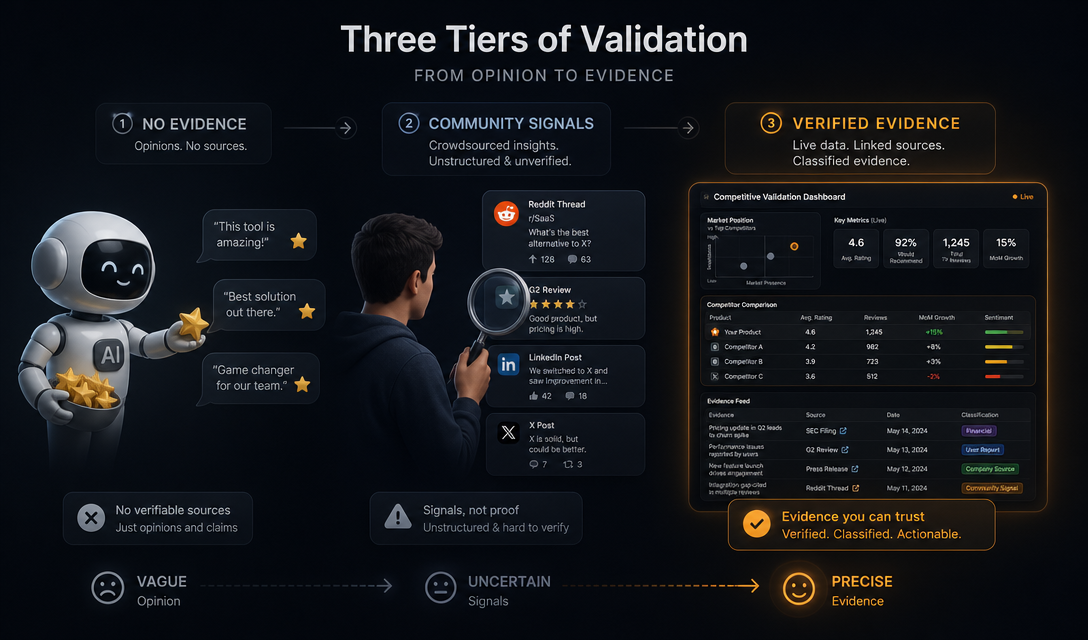
This pre-screen is powerful for the paradox-of-competence founder because it replaces subjective judgment with observable evidence. You're not asking "do I think this is a good idea?" — you're asking "does evidence of demand already exist in public?" The answer is a search query, not an existential crisis.
More importantly, it breaks the paralysis loop. The paradox-of-competence founder gets stuck because every idea triggers all four failure modes simultaneously. The pre-screen narrows the field: ideas with no public demand signal get eliminated immediately, without requiring weeks of research or interviews. You stop evaluating your own creativity and start reading market evidence.
The Shift That Changes Everything
Here's what changed for founders who broke through the paradox: they stopped trying to find the perfect idea and started looking for a validated problem.
The distinction matters. An "idea" is a solution in search of a market. A "validated problem" is market demand that already exists, waiting for a better solution. The Harvard/Oxford engineer was hunting for ideas — unsexy B2B problems, vertical SaaS opportunities — and killing each one against his internal failure-mode checklist.
The alternative is to hunt for evidence instead. Search for the complaints. Find the tools people are paying for but complaining about. Look for the Reddit threads where people describe their workarounds. That's not "ideation" in the traditional sense — it's market research with a specific, answerable question:
What are people already trying to pay for, and why isn't the current solution good enough?
When you shift from "is my idea good?" to "is this problem real and urgent?", you stop evaluating your own creativity and start evaluating market evidence. The most dangerous validation is when people say "great idea" but never open their wallet — and the only way past that is to stop collecting encouragement and start looking for commitment.
The paradox of competence doesn't resolve by thinking harder. It resolves by replacing thinking with evidence — and by recognizing that the first step isn't a business plan or an MVP. It's a search query.
Further reading: CB Insights — Top Reasons Startups Fail | GrowWithSakib — Validate a Niche Before Building | BLS — Business Employment Dynamics